


Is your research helping you understand the digitally engaged consumer?
share on
The way consumers shop has changed considerably. Technology creates endless opportunities for consumers to search and purchase products, and to interact with brands. For marketers, technology opens up new communication channels and a wealth of targeting capabilities. But it’s a balancing act - what, where and when, let alone how to then substantiate and track the results.
Technology has also transformed the personality of brands; they crave Facebook “likes” and Twitter Followers. Asia-Pacific’s 2013 online spend grew by 43%, the highest globally (Nielsen, Global Adview Pulse Lite), backing up the need for better customer understanding. Thankfully, moving at the same pace is the release of research technologies that bring us a 360⁰ view of consumer attitudes, needs and behaviour.
One of the major advances has been the rise in the use and the capability of mobile phones and this is particularly evident in the Asia Pacific region. APAC has the highest percentage of smartphones globally (76%) and more APAC users turn on their mobile device throughout the day than the global norm.
Consumers’ online lives are no longer a mystery; they can be metered, tracked and cookied with tools that are precise and opted-in. With this in mind, Research Now leveraged the single-source methodology and complemented it with multiple technologies to explore how the traditional lines up against the new? But did it provide us with the right balance of consumer insights?
Using the same panelists across different studies, we surveyed consumers in the US and UK to review shopping habits with an online questionnaire. This was complemented by passive data for website visitation (via PC or mobile) and, lastly, in-store visitation captured by users’ GPS Smartphones.
Findings
Here’s what we found:
It is imperative to measure and evaluate consumer behavior holistically - there’s a more complex world to discover, learn from and adapt brand strategies as consumers are engaging in a more complex path to purchase.
- What people say they search for online compared to what they do online are not the same. Surveys state the truth, but we need more contextual data to understand the full path to purchase. I may have decided to buy a new iPad for Christmas but what I saw online or in-store led me to buy something different. Understanding all touch points is crucial as each presents a different opportunity.
- The traditional path to purchase has changed beyond recognition. New channels in the shopping experience, such as mobile, are not as predictable as established PC behaviours. Consumers are more likely to do what they say they will when it comes to shopping via PC, but this does not translate to mobile or in-store shopping.
- Smartphone apps are a significant opportunity for brands given the amount of time and tasks performed on smartphones. Nevertheless, the technology is young in terms of adoption and learning, and still needs to develop its own voice to capture consumers’ attention “in the moment”.
The details
Search
Open-ended responses from a survey question (“If money was no object, what is the one thing you would like to receive this holiday?”) were mapped with search terms collected from behavioural tracking. Coded responses covered many categories but not the most prevalent item searched online (Onesies and Ugg boots!)
Traffic
We selected a list of the 20 most popular retailers and tracked respondents’ behavior via PC and smartphone. For the first time we were able to access a complete picture of consumers’ behaviours, and to start noting new consumer trends.
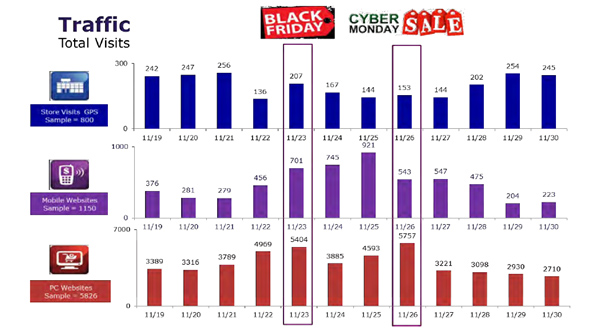
Reading the chart: The blue bars show results from GPS, location-based mobile data, purple bars show website visitation via mobile whilst red bars show website visitation via PC.
22November was Thanksgiving Day, as noted in the blue bars. Three days prior, shopping in-store was high in preparation for the holiday but on the 22nd traffic was lower, as most stores were closed for family holidays. But what were they doing in addition to spending time with their families? The other bars (in purple and red), indicate they were also on their PCs, browsing retailers’ websites and searching for upcoming Black Friday deals – when the US online retail world goes crazy on promotion.
The success of online sales is further supported by higher PC and mobile activity on Black Friday when shoppers chose to purchase in the peace of their own homes. In addition, mobile traffic peaked on the weekend, which aligns with the industry trend. This presents a new opportunity for brands to engage differently with consumers on weekends versus week days.
Store Visitation
To evaluate physical store visitation, we asked respondents to report which retailers they were planning to visit. For the same purpose, we tracked respondents on their Smartphones with an activated GPS location-based capability. There was a clear misalignment between the survey and passive behavioural data. Respondents didn’t visit the stores they mentioned in the online survey.
Website Visitation
PC browsing is more established. Our survey and behavioural data were closely aligned as respondents browsed the same websites via PC they said they were going to browse in the survey. However, with mobile website browsing the opposite happened; respondents said they were going to browse certain websites on their mobile device but didn’t visit the same websites as intended.
Smartphone app usage
When we tracked mobile devices against consumer reported intent, there were notable differences. Respondents with apps on their smartphones didn’t use them when in-store. Yes, they were busy on their phones but the majority spent time on Facebook, videos and games and not on related retail activity.
So, I put it to you, do new technologies provide us with the right balance of consumer insights when compared to traditional surveys? It’s an overwhelming “YES”- and the insights are also richer.
The writer is Elizabeth May, vice president client development, Research Now.
Research Now is the gold sponsor of Research Asia Interactive.
To book your seats for the conference contact Carlo Reston at carlor@marketing-interactive.com or +65 6423 0329, +65 9727 0291.
For sponsorship opportunities, contact Che Winstrom at chew@marketing-interactive.com or +65 6423 0329.
To discuss the agenda, enquire about presenting or to suggest topics, contact Preeti Varadarajan at preetiv@marketing-interactive.com or +65 6423 0329
share on

Free newsletter
Get the daily lowdown on Asia's top marketing stories.
We break down the big and messy topics of the day so you're updated on the most important developments in Asia's marketing development – for free.
subscribe now open in new window